

This summer, the Stoneham Civic Ledger will explore one of the most consequential topics shaping our community: how Massachusetts supports and funds its public primary schools, and how that has grown over the years. Over the coming months, we will trace the long arc of education in the Commonwealth, from the earliest colonial laws to the modern Chapter 70 formula, from the rise of the “common school” to the challenges facing today’s districts. We will examine performance, equity, and the structural forces that shape what towns like Stoneham can provide for their children.


This article in our summer series was co‑written with Carey McDonald, Malden City Councilor and candidate for State Senate, whose work on municipal finance brings valuable perspective to this topic. I have appreciated their thoughtful feedback and insights in writing this and the next article. You can learn more about their campaign platform on here.
Massachusetts Communities Are Struggling Today, and Why the System No Longer Fits the Realities of Prop 2½
For more than thirty years, Chapter 70 has been the backbone of school funding in Massachusetts. It helped lift statewide achievement, narrow gaps, and stabilize budgets. But the conditions that made the formula successful in the 1990s and 2000s no longer exist. Costs have surged, demographics have shifted, federal continues to decline, and municipal budgets are constrained by Prop 2½ in ways the original formula never anticipated.
The result is visible across the Commonwealth: towns forced into overrides just to maintain level services, districts cutting staff despite rising enrollment and needs, and communities struggling to fund schools alongside police, fire, DPW, libraries, and senior services. The formula has not kept pace with the world we live in now.
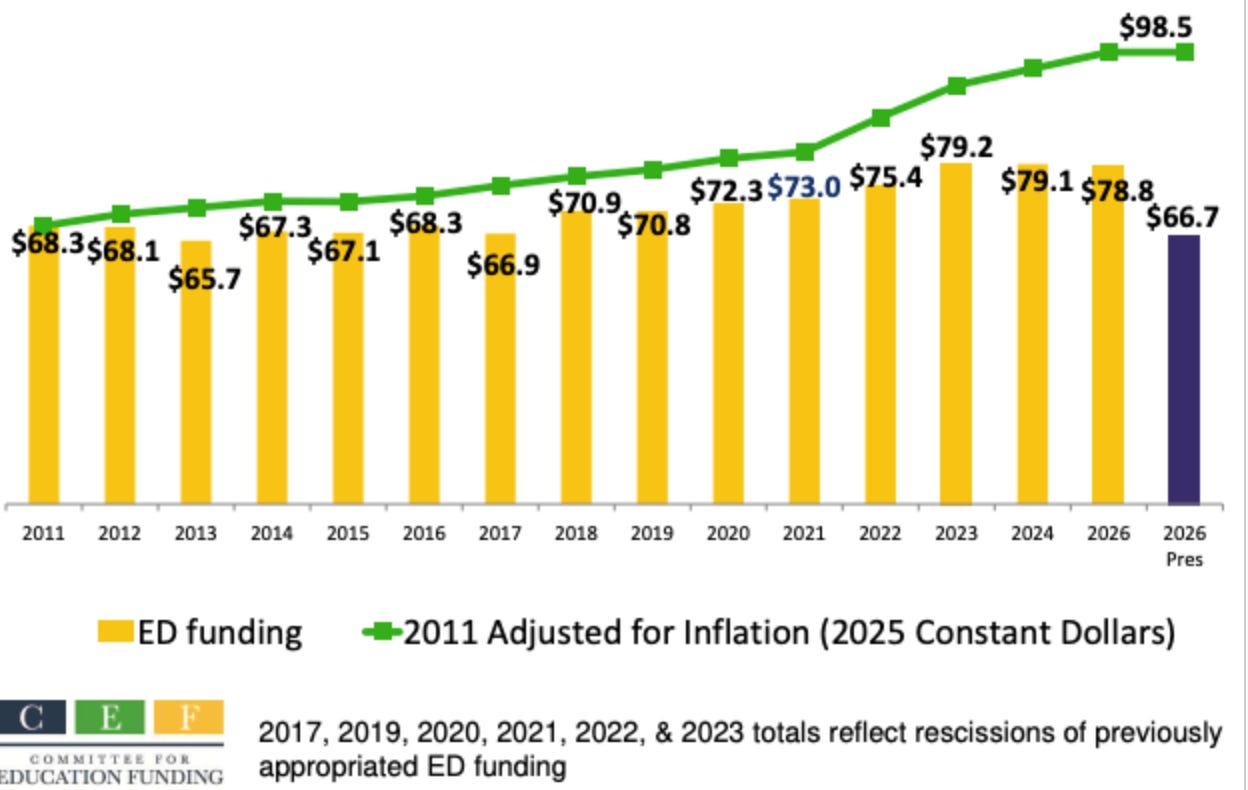
US Department of Education discretionary funding has declined vs. inflation annually, and taken a significant step back overall in 2026. This budget funds competitive, merit-based grants and targeted national programs chosen by Congress and the administration.
Inflation Has Outpaced Chapter 70, and Proposition 2½ Creates a Structural Mismatch
The Student Opportunity Act (SOA) delivered meaningful new dollars, especially for high‑need districts. But in the years since, inflation has eaten away those gains.
Recent budget cycles show the same pattern statewide:
Education inflation routinely runs 2%–4% higher than the inflation factor used in the formula.
Health insurance, transportation, and special education costs have risen even faster, often 8–12% annually.
Minimum aid districts receive $30–$75 per pupil, while many need $300–$600 per pupil just to maintain last year’s staffing and programming.
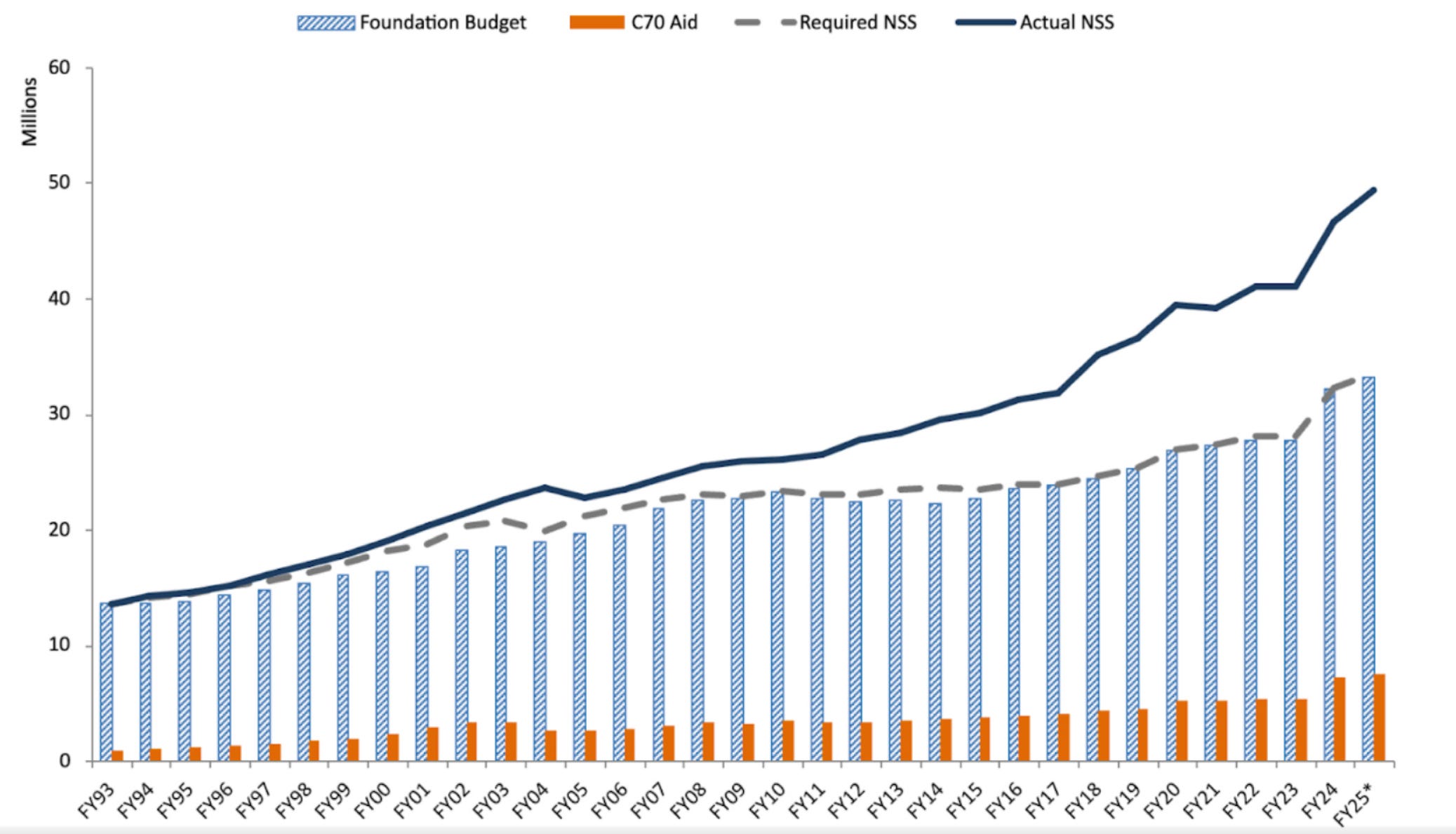
The increasing gap in state funding (orange bar) and actual Stoneham school department costs (black line). Taken from the Superintendent’s presentation to the override study committee, 8/20/2025.
Communities are now seeing the consequences: layoffs, reduced electives, larger class sizes, and deferred maintenance. These aren’t theoretical warnings, they’re real outcomes happening right now in towns across Massachusetts.
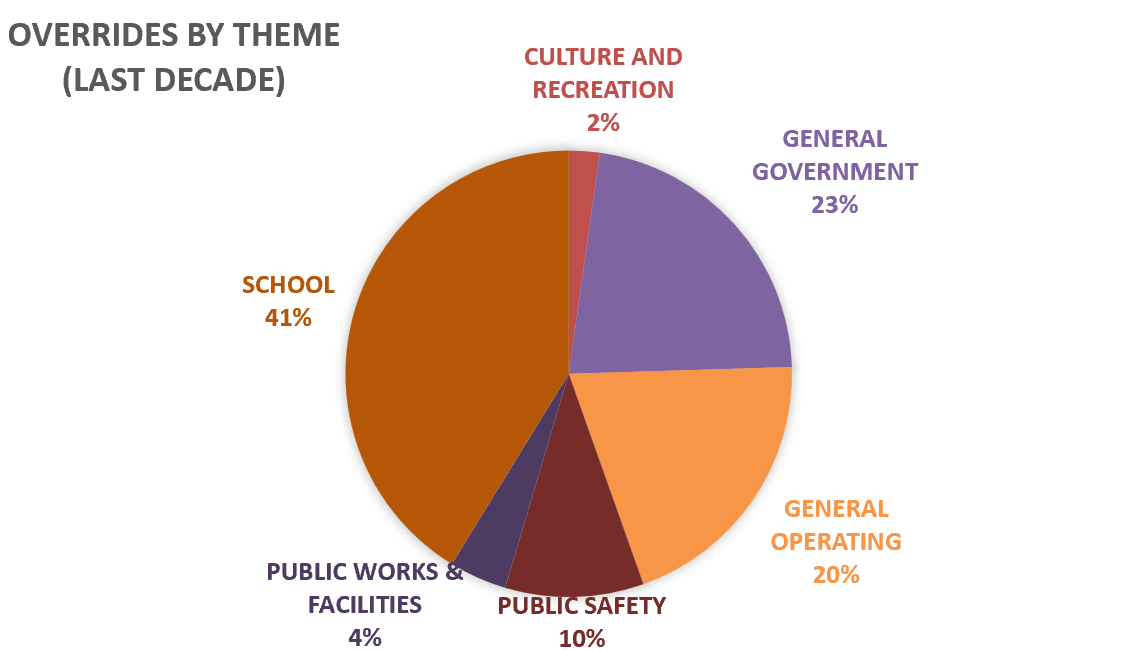
Schools have been the #1 driver of overrides over the last decade. Data
As a result, overrides have shifted from being infrequent, one‑time measures for new programs to becoming routine survival tools. Towns now seek overrides simply to keep teachers in classrooms, maintain electives, and avoid cutting essential services. The local contribution formula compounds the problem by demanding that some municipalities devote 60%+ of their entire levy limit to meet required school funding levels, leaving little room for police, fire, DPW, libraries, or senior services. Communities with modest tax bases or limited commercial growth feel this pressure most acutely. The outcome is a cycle of override votes, budget cuts, and growing inequity between towns that can pass overrides and those that cannot.
Local Contribution Requirements Don’t Reflect Real Capacity
The local contribution formula leans heavily on property values and aggregate income to determine what a community “should” be able to afford, but these metrics break down completely under Proposition 2½. Rising property values do not increase a town’s actual revenue, only its assessed wealth in the eyes of the state.
Consider a town whose total valuation jumps from $3 billion to $3.6 billion because of a hot real‑estate market. Under Chapter 70, that 20% increase signals new fiscal capacity, and the town’s required local contribution rises accordingly. But under Prop 2½, the town’s levy limit still grows by only 2.5 %. The community cannot access the additional $600 million in valuation without passing an override, yet the formula treats that valuation growth as spendable money. The same problem occurs with aggregate income. A town may show $1.2 billion in total resident income, but if a small number of high‑earning households drive that figure, the formula will classify the town as “wealthy” even if most residents are middle‑income and already stretched by housing, childcare, and healthcare costs. Aggregate income does not reflect how much of that income is taxable either, nor does it account for the fact that municipal budgets cannot tap resident earnings directly, they rely on property taxes constrained by Prop 2½.
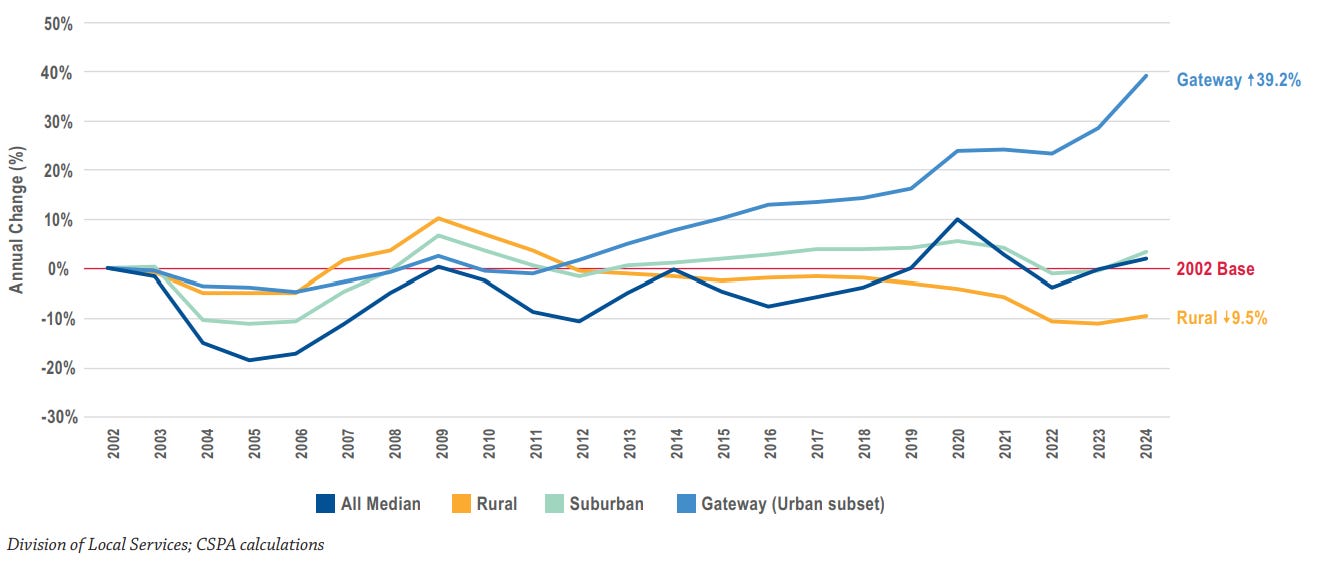
Variability of education aid across cities and towns in MA.
This mismatch becomes stark when you look at real‑world cases. Imagine two communities with similar property values and aggregate income: Town A has a strong commercial base and steady new growth; Town B is mostly residential with little commercial development. Under the formula, both towns may be assigned a required local contribution equal to 50% of their levy limit. Town A can absorb this because new growth expands its levy capacity each year. Town B cannot, its levy grows only 2.5 % annually, while its fixed costs (public safety staffing, health insurance, pensions, DPW operations) rise 5–7 %. Even though Town B’s property values and aggregate income look robust on paper, its actual fiscal flexibility is far lower.
Special Education Costs Are Surging Beyond What the Formula Assumes
Special education is both a moral and legal obligation, and districts across Massachusetts are unwavering in their commitment to meeting it. But the cost structure has shifted so dramatically that communities are now struggling to keep pace. Out‑of‑district tuition has risen >10% percent annually, driven by higher staffing ratios, specialized therapeutic services, and increased placements for students with complex needs. Transportation costs, especially for out‑of‑district riders, have climbed even faster, and the Massachusetts Office of the Inspector General has repeatedly documented that SPED transportation is consistently the highest and fastest‑growing category of municipal transportation spending. Circuit breaker reimbursements help, but they cover only a portion of eligible costs and arrive later, leaving districts to absorb large, immediate increases within already‑strained budgets. When these mandated costs spike, districts have no flexibility: they must fulfill their legal obligations, even if it means cutting electives, paraprofessional support, classroom materials, technology upgrades, or core staffing. Communities across the Commonwealth now face an impossible tradeoff, meeting mandated SPED services while trying to maintain a stable, equitable educational experience for all students.
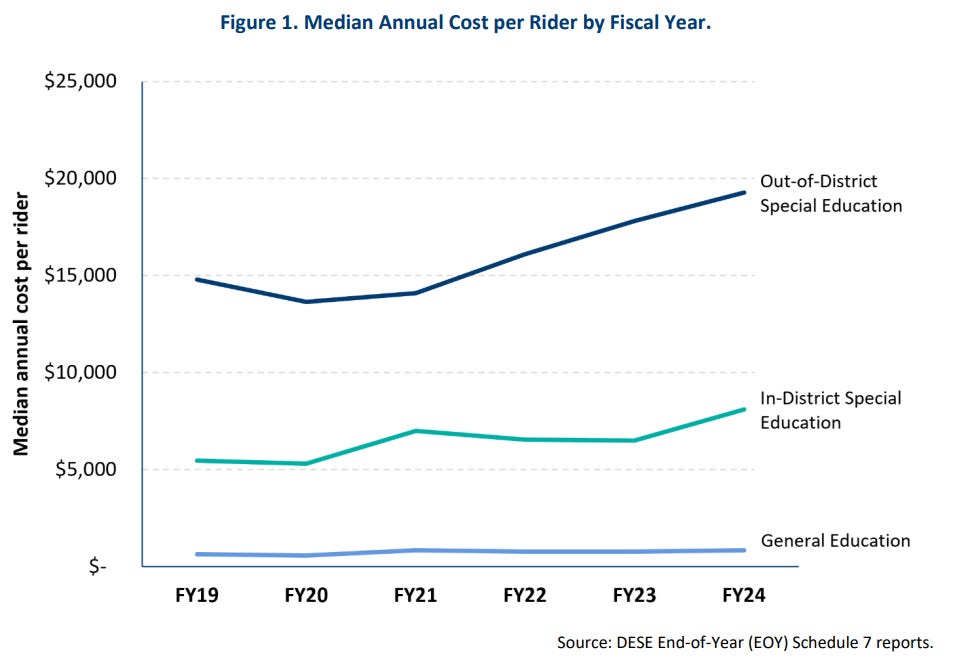
Annual transportation costs are consistently highest for out-of-district special education riders, and continue to rise. Office of the Inspector General. MASS OIG
Education groups across Massachusetts agree that the current system is unsustainable without targeted reforms. Increasing circuit breaker reimbursement would better reflect the true cost of high‑need placements and reduce the volatility that districts experience year to year. Direct state funding for certain SPED transportation expenses would relieve towns of one of their most unpredictable and rapidly escalating obligations. Updating foundation budget assumptions to match real SPED costs, rather than outdated averages, would prevent districts from starting each fiscal year in a deficit. Together, these changes would stabilize municipal budgets, protect services for students with disabilities, and reduce the override pressure that now defines school finance in many communities. Without modernization, towns will continue to face painful choices between fulfilling legal mandates and preserving the core programming that benefits all students.
Out‑of‑district tuition increases of 8–12% annually
Transportation increases of 10–15%
A Formula Built for the 1990s Cannot Meet the Needs of the 2020s
Massachusetts can’t fix a 1990s school‑funding formula without a loud, informed grassroots movement behind it. Costs are rising faster than Chapter 70’s inflation factor, federal education funding has fallen behind inflation, and Prop 2½ now forces towns into overrides just to maintain level services. If we want stable schools, stable municipal budgets, and a fair shot for every student, we need residents talking to each other—sharing this information with friends, neighbors, parent groups, and community networks—and bringing a unified message straight to the State House. Change will only happen if communities across the Commonwealth make it impossible to ignore.
What Residents Should Urge the State House to Fix
Update the foundation budget to reflect real inflation, SPED costs, transportation, and staffing pressures.
Modernize the local contribution formula so expectations align with levy limits and true fiscal capacity under Prop 2½.
Increase circuit breaker reimbursement and provide direct state support for SPED transportation.
Adjust Chapter 70 for declining federal education funding and stagnant unrestricted local aid.
Reduce reliance on Prop 2½ overrides so towns can maintain level services without crisis‑driven tax increases.