

This summer, the Stoneham Civic Ledger will explore one of the most consequential topics shaping our community: how Massachusetts supports and funds its public primary schools, and how that has grown over the years. Over the coming months, we will trace the long arc of education in the Commonwealth, from the earliest colonial laws to the modern Chapter 70 formula, from the rise of the “common school” to the challenges facing today’s districts. We will examine performance, equity, and the structural forces that shape what towns like Stoneham can provide for their children.

How Chapter 70 Was Built
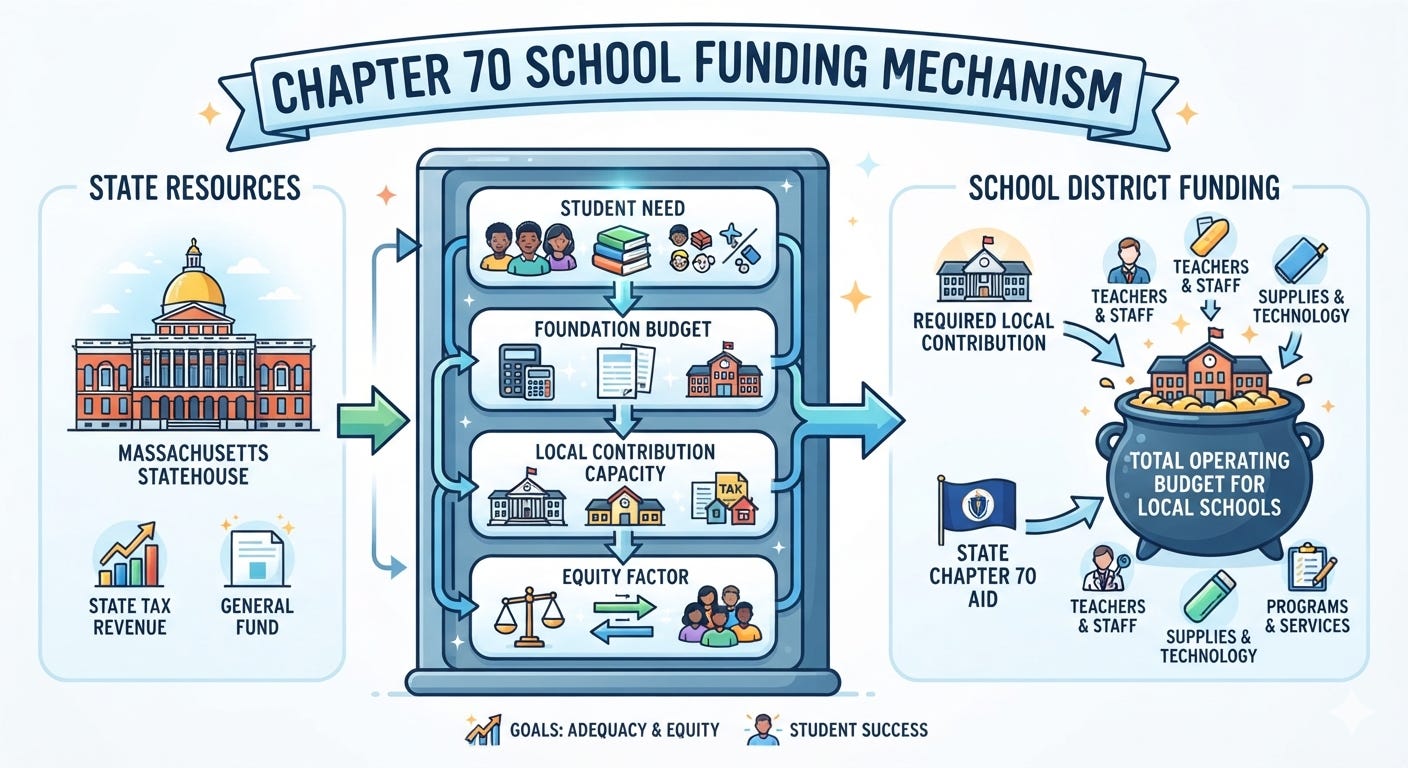
Chapter 70 is the Commonwealth’s primary mechanism for funding public schools. It determines how much state aid each district receives and how much each community must contribute locally. While it is often described as a “formula,” it is more accurately a policy framework that has evolved over decades, shaped by court rulings, legislative compromises, demographic changes, and political pressure from communities across Massachusetts.
Origins: The Education Reform Act of 1993
The modern Chapter 70 formula was born out of the landmark McDuffy vs. Secretary of the Executive Office of Education (1993) decision. The Supreme Judicial Court ruled that the state had a constitutional obligation to ensure all students, regardless of zip code, received an adequate education. Beacon Hill responded with the Education Reform Act, which created:
A statewide “foundation budget” defining the minimum cost to educate a student
A required local contribution based on municipal wealth
State aid to fill the gap between local capacity and foundation needs
Accountability measures and curriculum standards
This was the first attempt to equalize resources between wealthy suburbs and high‑need urban districts.
Political Dynamics on Beacon Hill
Over time, the formula became a battleground between three broad groups:
Gateway Cities (e.g., Lawrence, Lowell, Brockton)
Advocated for higher aid due to concentrated poverty, English learner needs, and aging infrastructure.
High‑wealth suburbs (e.g., Wellesley, Weston, Dover)
Pushed for flexibility and resisted increases in required local contributions.
Mid‑sized suburbs
Not wealthy enough to self‑fund comfortably
Not high‑need enough to qualify for major state adjustments
Often left out of major reforms because they do not fit either extreme
Stoneham, like many other similar sized and demographic communities’ structural challenges are rooted in this political history: we are neither rich nor poor enough to benefit from the formula’s adjustments.
The Chapter 70 ‘Formula’
At its core, Chapter 70 calculates:
State Aid = Foundation Budget − Required Local Contribution
Described in two simple sentences: it starts by calculating a district’s foundation budget, which is the state’s estimate of the minimum cost to educate its students. The state then subtracts the required local contribution, and whatever remains becomes the district’s Chapter 70 education aid.
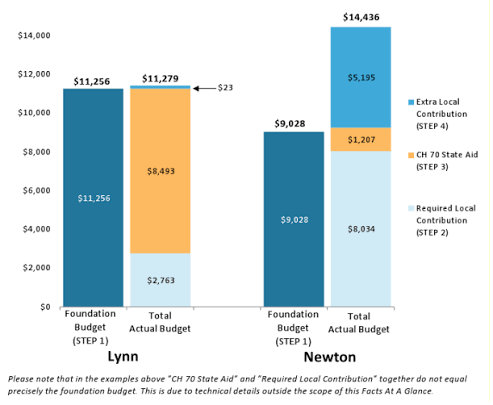
Example of the foundation budget (per pupil), and the contributions from state and local governments to meet that budget for two different communities. Contributions from local towns/cities will vary greatly.
But each component contains multiple layers.
Foundation Budget (What the state says it costs to educate students)
The foundation budget is built from cost factors multiplied by enrollment categories. Key elements include:
Base per‑pupil rate - A standard cost applied to every student.
Grade‑level weights - Higher costs for high school students, lower for elementary.
Low‑income increment - Additional funding for students from economically disadvantaged households.
English learner increment - Additional funding for students learning English.
Special education assumptions - A fixed percentage of students assumed to require services (not actual enrollment).
Employee benefits & fixed charges -A state‑defined rate that often underestimates real healthcare and pension costs.
Programmatic categories - Instruction, administration, operations, transportation (limited), and other mandated services.
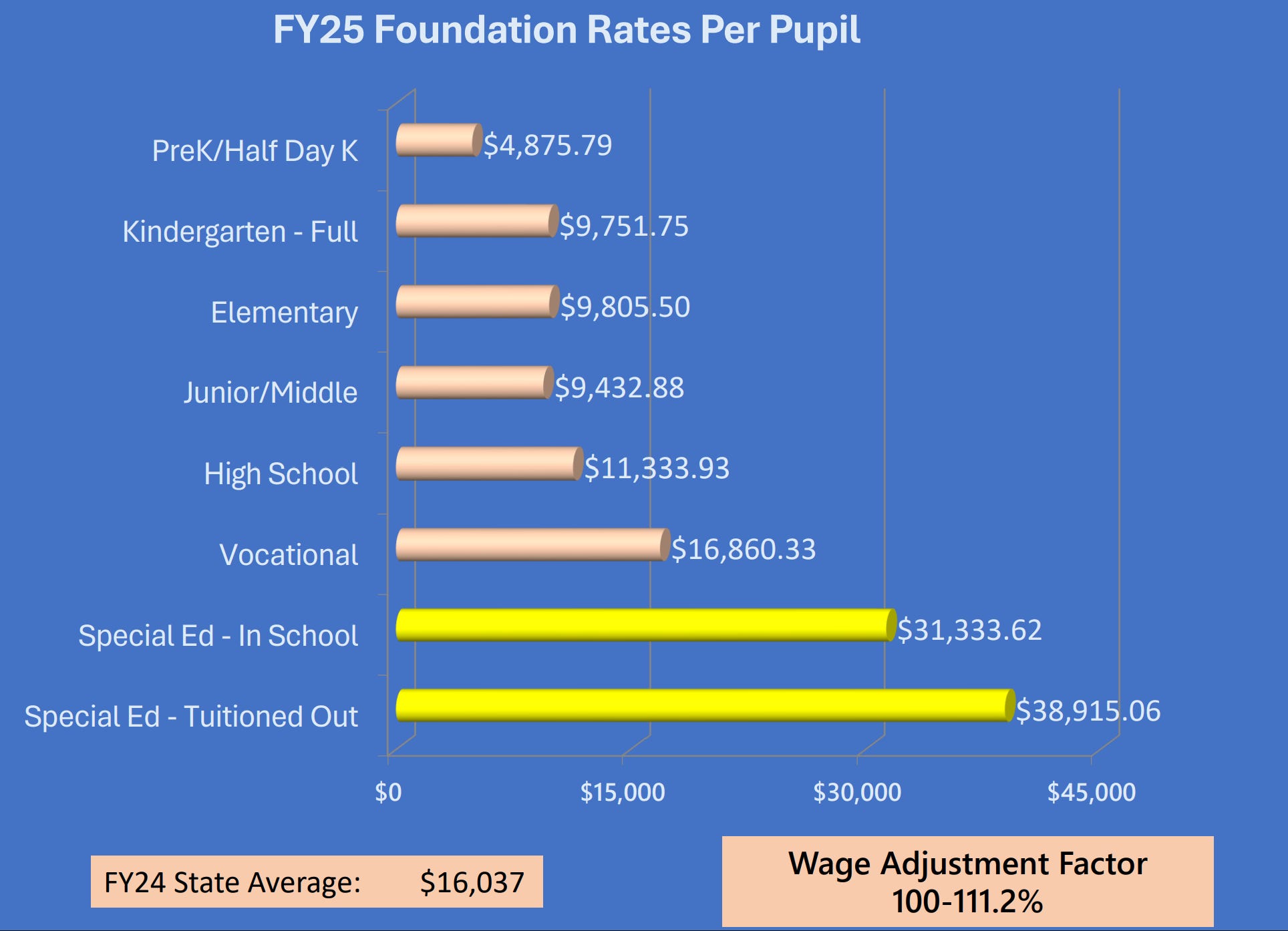
Example foundation budget per-pupil rates for various grade levels and special education.
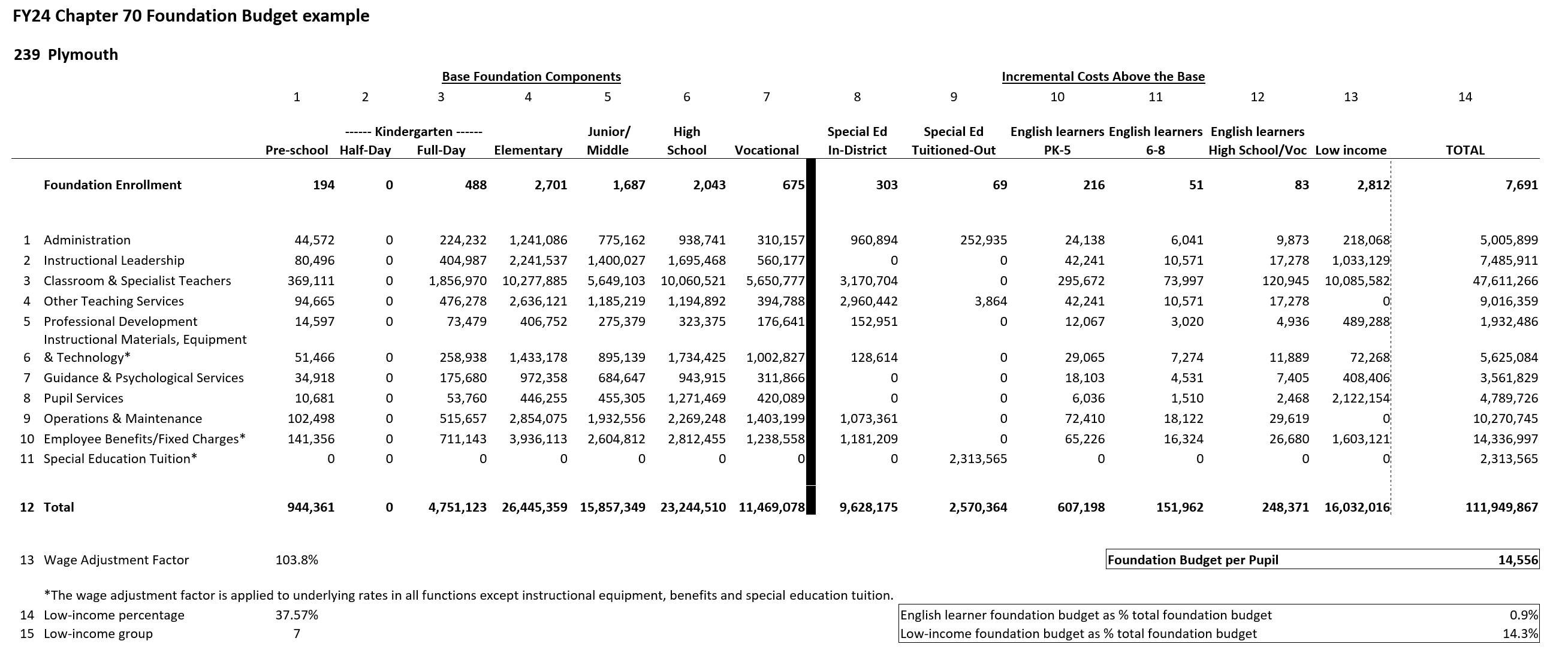
Example line-line foundation budget from Plymouth, MA - 2024.
Required Local Contribution (What the town must pay)
The required local contribution is the amount of money the state says a municipality must pay toward its school budget each year. Think of it as the state’s way of saying:
“Here is your minimum share.”
The state calculates this number using two things:
How much property value a city or town has
(called “equalized valuation,” but you don’t need that term)How much income residents earn overall
If a town has higher property values or higher incomes, the state assumes it can afford to pay more. If a town has lower values or lower incomes, the state assumes it can afford less.
Once the state looks at those two numbers, it sets a municipalities’ required contribution. This number is not based on what it actually spends, and it’s not based on what its schools actually cost. It is simply the state’s estimate of what it should be able to pay.
The formula is also designed to have a cap of 17.5% , so that no community is asked to fund more than 82.5% of its foundation budget.
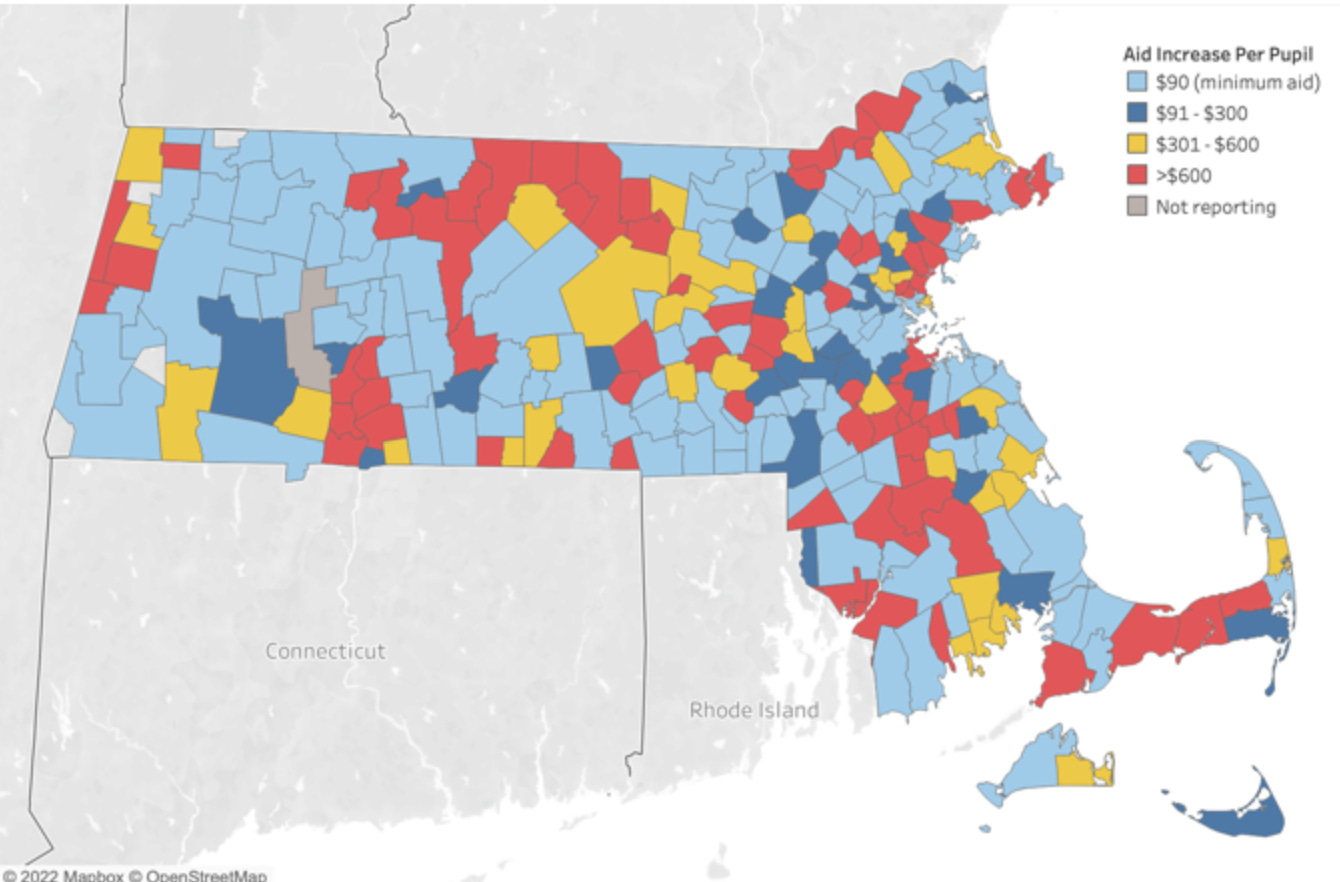
Geographic distribution of Local Aid for FY2023.
Once the state calculates Stoneham’s required local contribution, it doesn’t simply lock that number in place forever. Instead, the state applies a series of annual adjustments to move each community toward what Beacon Hill believes is its “fair share.” These adjustments are meant to smooth out big jumps, correct long‑term imbalances, and keep towns on a predictable path.
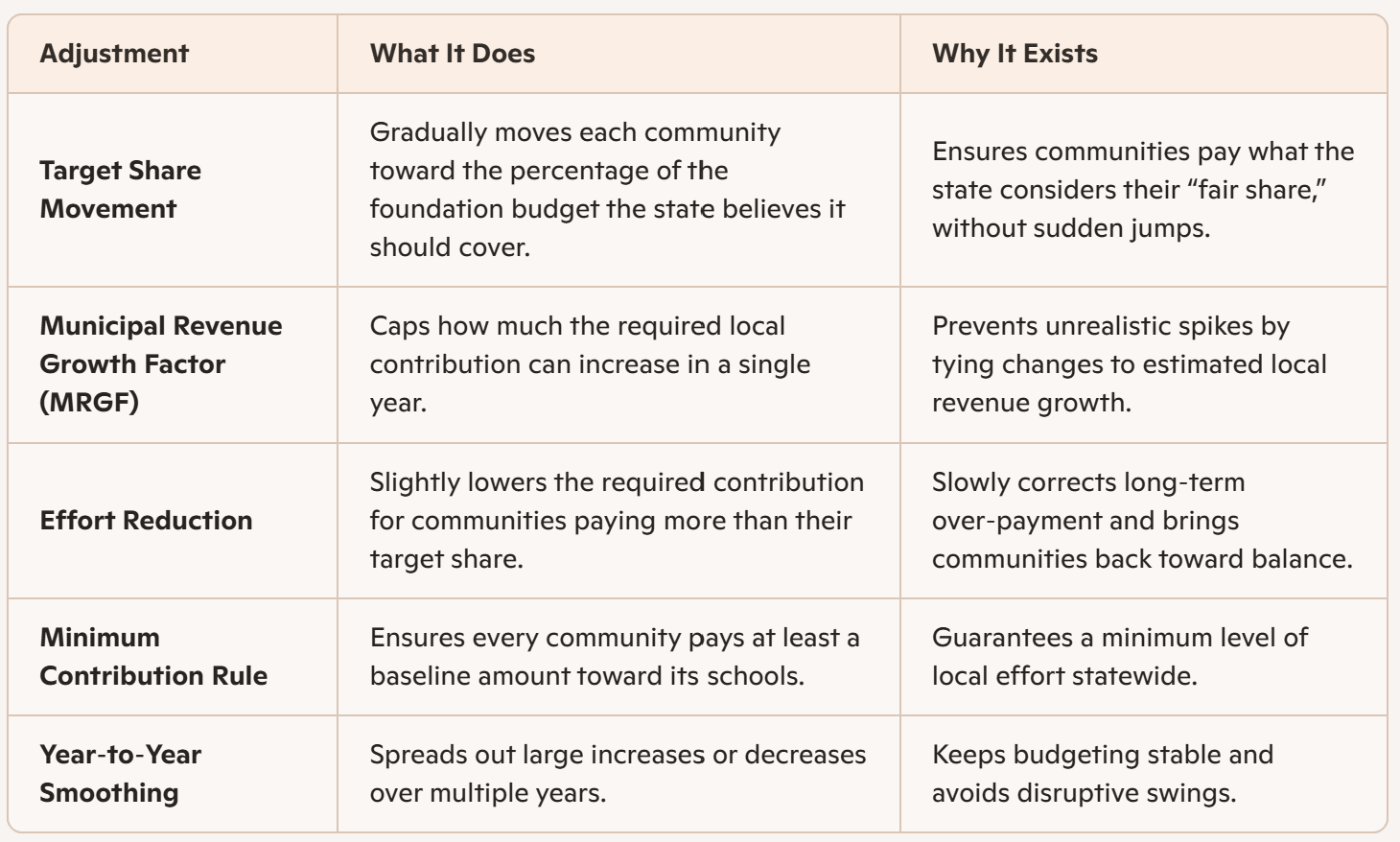
The Intent of the Formula: What Chapter 70 Was Designed to Do
The intent behind Chapter 70 was ambitious. Lawmakers wanted a formula that could level the playing field without erasing local control. They envisioned a system where the state would define the minimum cost of educating a child, the “foundation budget”, and then determine how much each community could reasonably contribute based on its income and property wealth. If a town could not meet its foundation budget, the state would step in with aid. If a town could meet it, the state would provide only a small amount of additional support.
In theory, this approach would ensure fairness: communities with fewer resources would receive more help, and communities with greater resources would shoulder more of the cost. It was meant to be predictable, stable, and insulated from political swings. And it was meant to encourage local effort, towns were expected to contribute their fair share, but not more than what the state believed they could afford.
Over time, however, the intent of the formula collided with the realities of municipal finance. Costs rose faster than the formula’s assumptions. Healthcare and special education expenses grew dramatically. Demographics shifted. The formula’s original design still aimed to equalize opportunity, but its outdated assumptions began to distort how aid was distributed.
For Stoneham, this mismatch is especially visible. We are not a high‑wealth suburb with a large tax base, nor are we a Gateway City with concentrated poverty. We sit in the middle, a community with moderate resources, moderate needs, and a strong commitment to our schools. Yet the formula treats us as if we can comfortably fund our foundation budget without meaningful state assistance. The intent of Chapter 70 was to ensure that no community fell through the cracks. But mid‑sized suburbs like Stoneham increasingly find themselves in exactly that position: too “wealthy” to qualify for significant aid, too constrained to meet rising costs without local overrides.
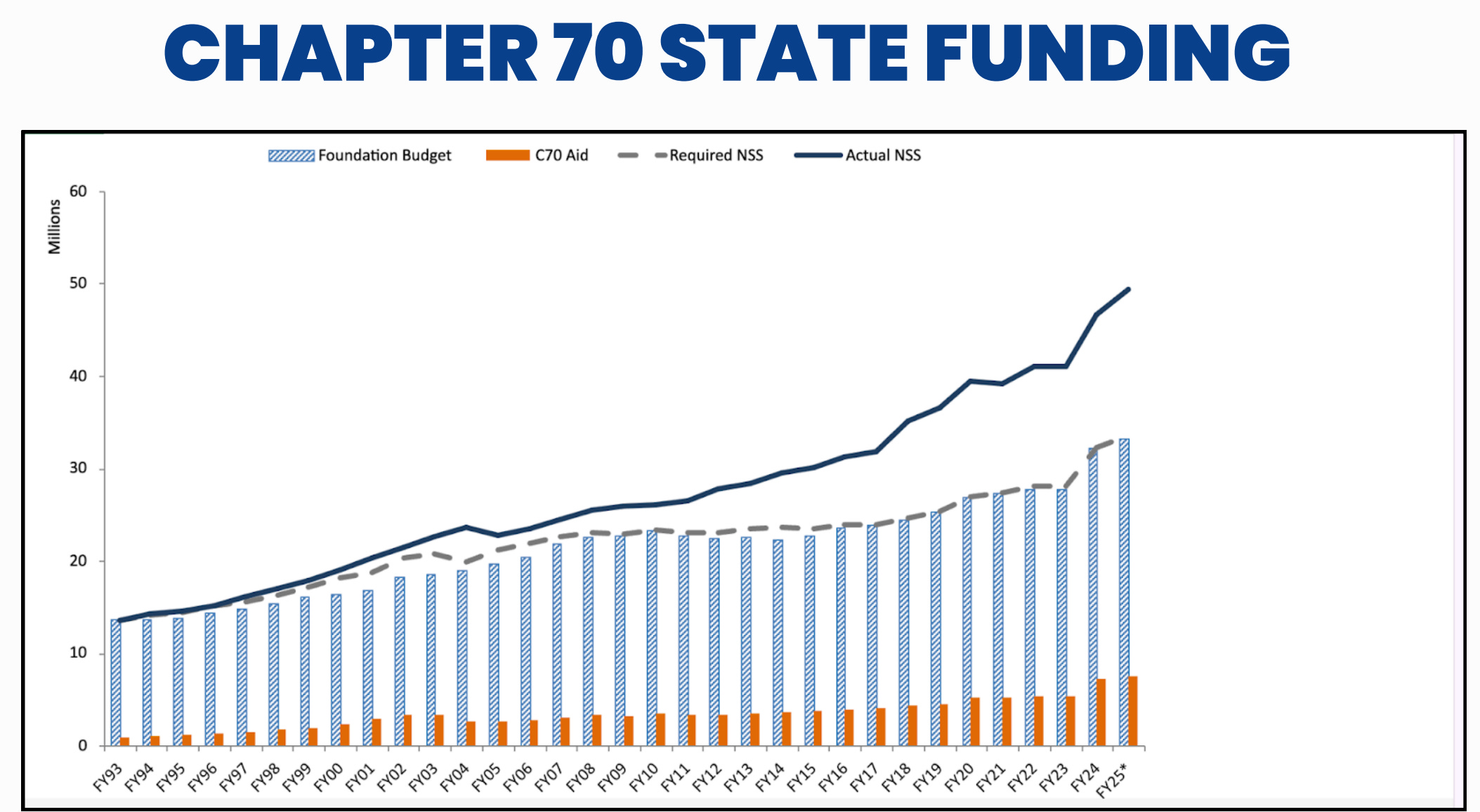
The increasing gap in state funding (orange bar) and actual department costs (black line). Taken from the Superintendent’s presentation to the override study committee, 8/20/2025.
In summary
Understanding how Chapter 70 works, its history, its math, its intent, and its adjustments, makes it easier to see why school funding debates continue across Massachusetts. The system aims for fairness and stability, but it moves gradually and often struggles to match the realities of modern education. That tension is at the heart of many local budget discussions. It is also why conversations about updating or modernizing the formula continue today.
A clear grasp of Chapter 70 is the first step toward meaningful reform. The more communities understand how the system works, the better positioned they are to advocate for changes that reflect today’s needs, today’s costs, and today’s students.