
Transparency in Bargaining: Opening the Books on the Stoneham Teacher's Contract Negotiations
Effort has been made on providing updates and insights into the Stoneham Teacher's 2026 contract negotiations. To further this communication and transparency, The Ledger has consolidated it all!

This article was published originally on March 23rd, 2026. This information is the best we have as of that date.
The Post Override Setting
Since the passing of the successful override on December 9th 2025, contract negotiations between the Stoneham Educators Association (SEA) and the Stoneham School Committee (SSC), have been ongoing. At this pivotal moment, where Stoneham’s first ever override meets a 6+ month overdue contract negotiation to bring Stoneham teachers from the bottom of the area’s pay scale, our residents are starting to pay attention.
At the Civic Ledger, one of our guiding principles is simple: public decisions deserve public math. In science and engineering, the fields I was trained in, no conclusion is accepted without showing the work. Assumptions are stated plainly. Models are open to scrutiny. Peers challenge the numbers, strengthen them, or correct them. That transparency isn’t a luxury, it’s the foundation of trust.
Municipal government and finance should operate the same way whenever possible.
Teacher contracts are among the largest and most consequential financial commitments a town makes. They influence classroom stability, student experience, long‑term budgeting, and the town’s ability to recruit and retain great educators. Yet the underlying numbers often remain opaque to the public. This article will aim to change that.
Where We Start With the Current (Expired) Contract
The average teacher salary in Stoneham is about 10% below the state average and trails every one of these neighboring districts. The gap is nearly, or over, $10,000 in nearby communities like Melrose, Wakefield, and Reading, which compete directly with Stoneham for talent, especially in high‑demand subject areas like STEM and special education.
A $5,000 - $10,000 difference can be enough to sway a mid‑career teacher weighing offers, especially when combined with differences in professional development time, class sizes, or extracurricular stipends. Over time, these disparities contribute to higher turnover, longer vacancy periods, and the loss of institutional knowledge that enables schools to run smoothly.
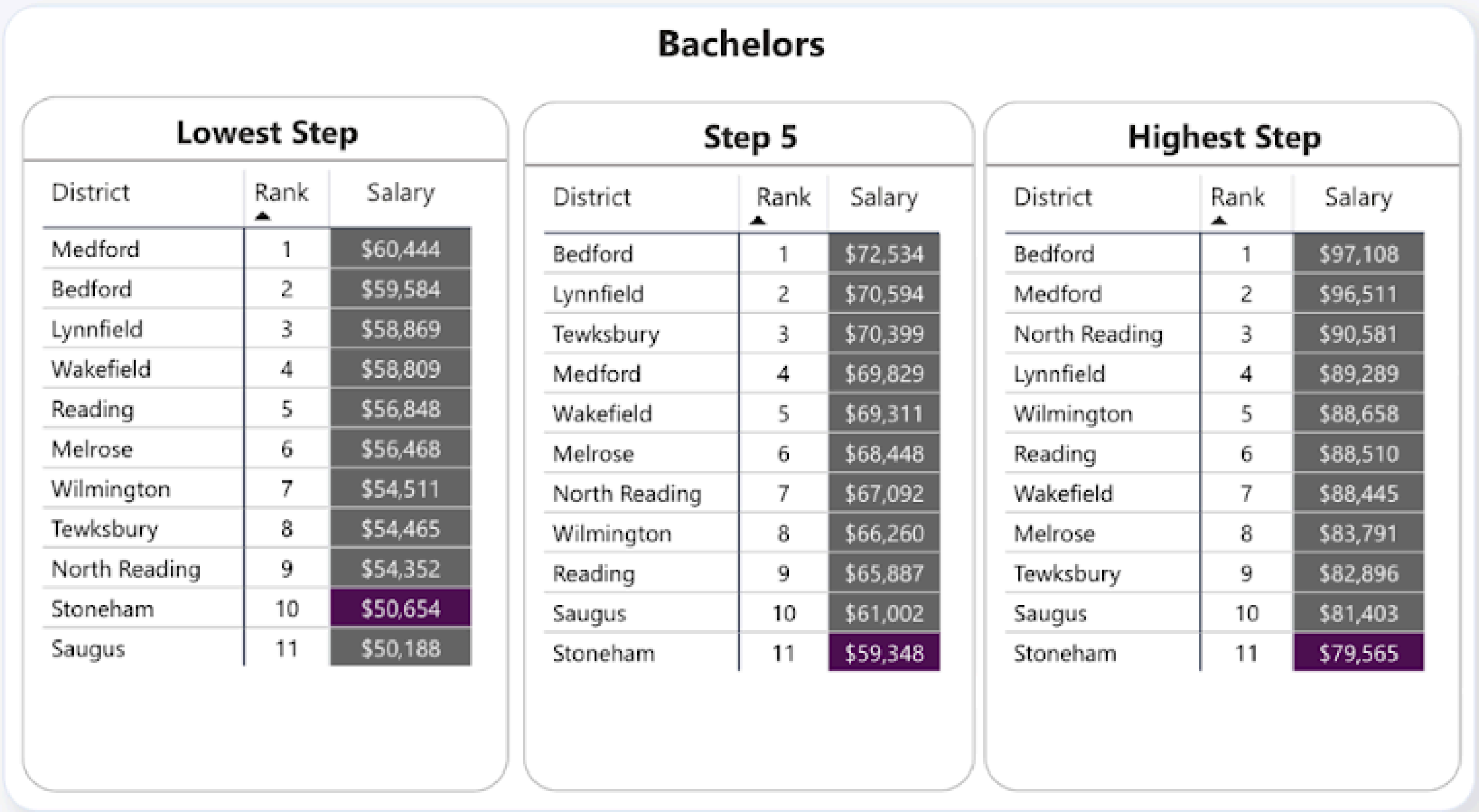
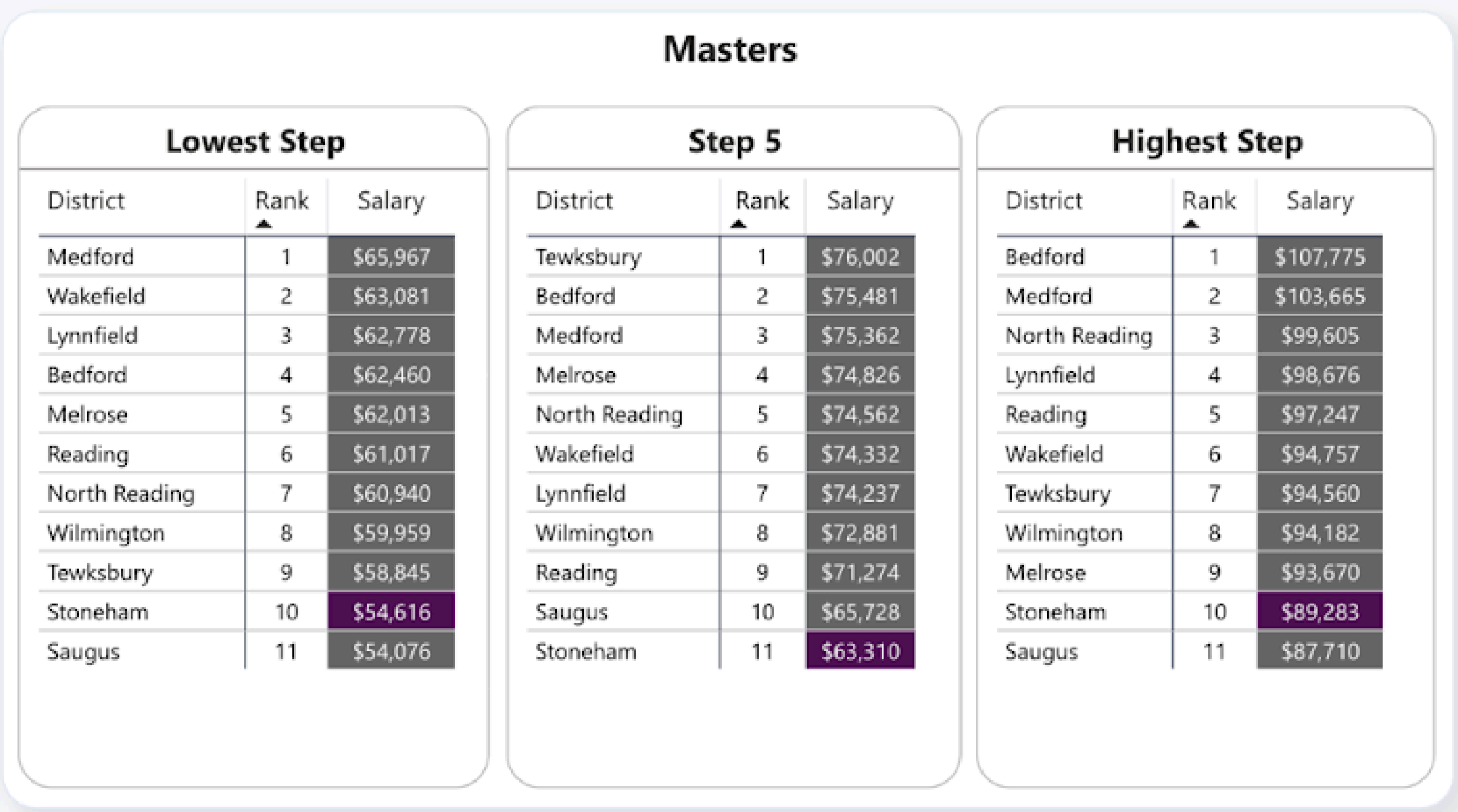
From Superintendent’s presentation to the OSC, August 20th, 2025
What the Override Recommends ($4.6M)
The December 9th override recommendations, for both the $12.5M and the $9.3M questions, recommended $4.6M for SPS ‘Contracts Flexibility’. For reference, the overall SPS budget for FY26 is $39.5M with over 80% allocated to teacher salaries. Additionally, a significant percentage of the $14M Shared Services budget (e.g., healthcare) goes to the teachers as well.
While the ballot question itself did not earmark dollars for any single purpose, the additional operating levy gives the district the financial runway to support SEA contracts and the above recommendation gives strong guidance on what that number should be. However, it is important to note that all appropriations, including any funds that ultimately support a negotiated contract, must still be approved by Town Meeting, which remains the final authority on municipal and school budgets.
Regardless, this $4.6M is our benchmark number we will use as an anchor for the increase in the FY27 salaries.
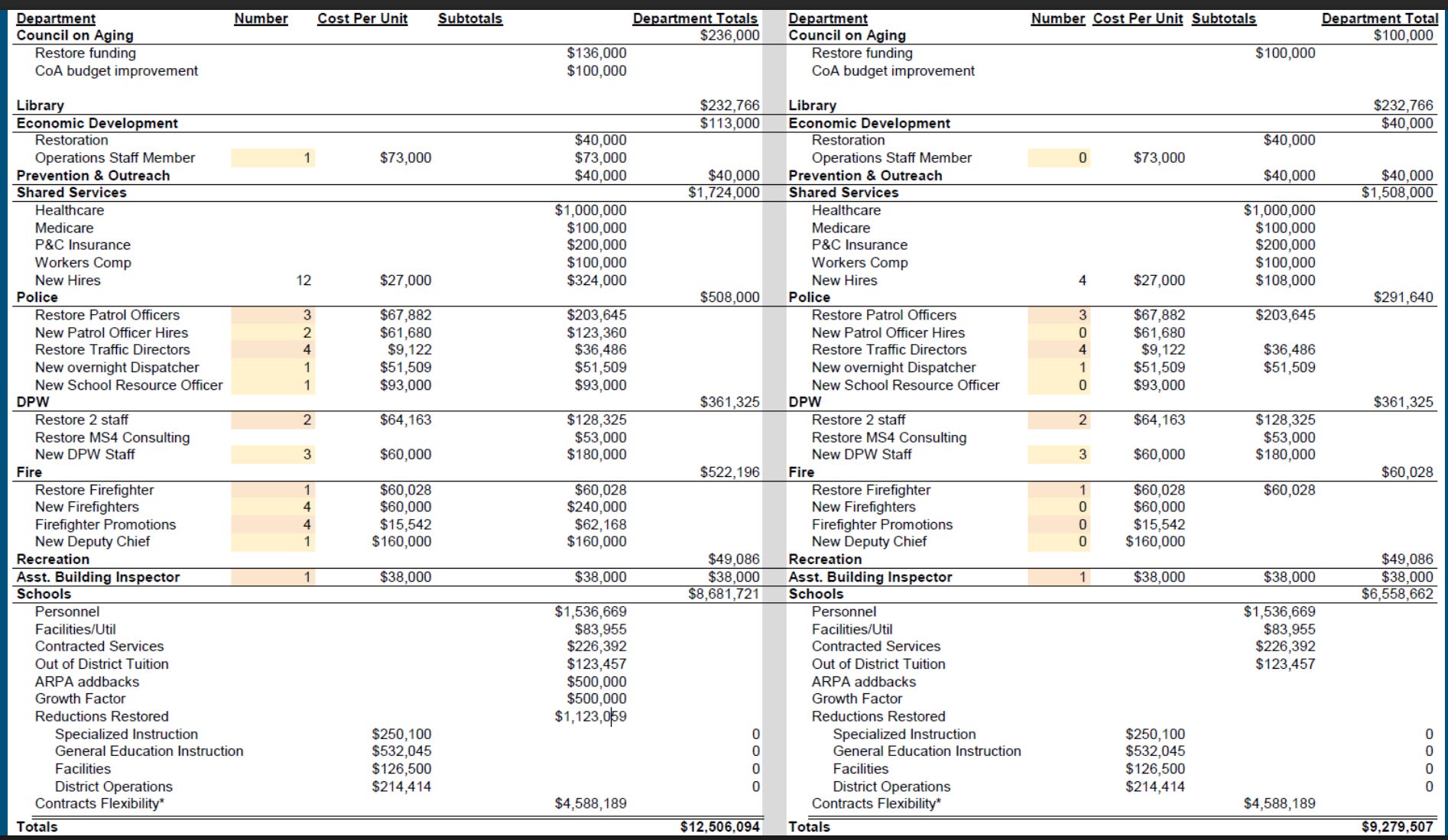
Recommendations for department line-by-line funding from override public engagement sessions. Contracts flexibility is the bottom line.
Baseline Goals for the SSC and SEA with the New Contract
Let’s start with the table-stakes, what each party has publicly stated they hoped to accomplish post-override. Undoubtedly, since there have been multiple negotiation sessions between December 9th 2025 and January 29th 2026, the commentary reflects some of the gaps that have been closed and some of the remaining issues.
From the SSC, in a press release on January 29th, 2026 (link):
Effective July 1, 2026
Salary offers bring all 3 units up to the mid-market rate of comparable districts
Add a new benefit of 2 weeks of paid parental leave, with the ability to use accrued sick time for additional paid leave
Expanded bereavement leave to include additional family members
Expanded sick leave to allow additional time to be used to care for family members
From the SEA, in a press release on January 29th, 2026 (link):
Modern parental leave policies that allow all Stoneham educators to bond with their new children.
Compassionate sick‑leave policies that let educators use their allotted sick days to care for family members in need.
Holiday pay for Education Support Professionals so they can move closer to a livable wage.
Autonomy over paycheck distribution so educators receive reliable and consistent paychecks during the summer weeks.
Fair, competitive market adjustments so Stoneham Public Schools can attract and retain high‑quality educators by the end of FY2029.
Where Negotiations Stand Today (Post 2/3 Meeting)
The SEA has made public, as they are free to do, details on the current terms of contract negotiations. The details from the SEA are as follows:
Primary Unresolved Issues
Compensation (which focuses not just on FY27, but where teacher salaries will land at the end of contract in FY29)
IMPORTANT: FOR PRESENTATION CLARITY I HAVE INCLUDED ONLY TEACHERS (UNIT A). ESPs/ABAs (Unit B) and secretaries (Unit C) are also included in this negotiation.
SEA presented a financial proposal aimed at moving Stoneham educators to the upper-middle of the local market over the contract term to support recruitment and retention.
SSC presented a financial proposal that would place Stoneham educators below average by the end of the contract in 2029. At the most recent meeting, no counterproposal was offered to SEA’s latest financial package.
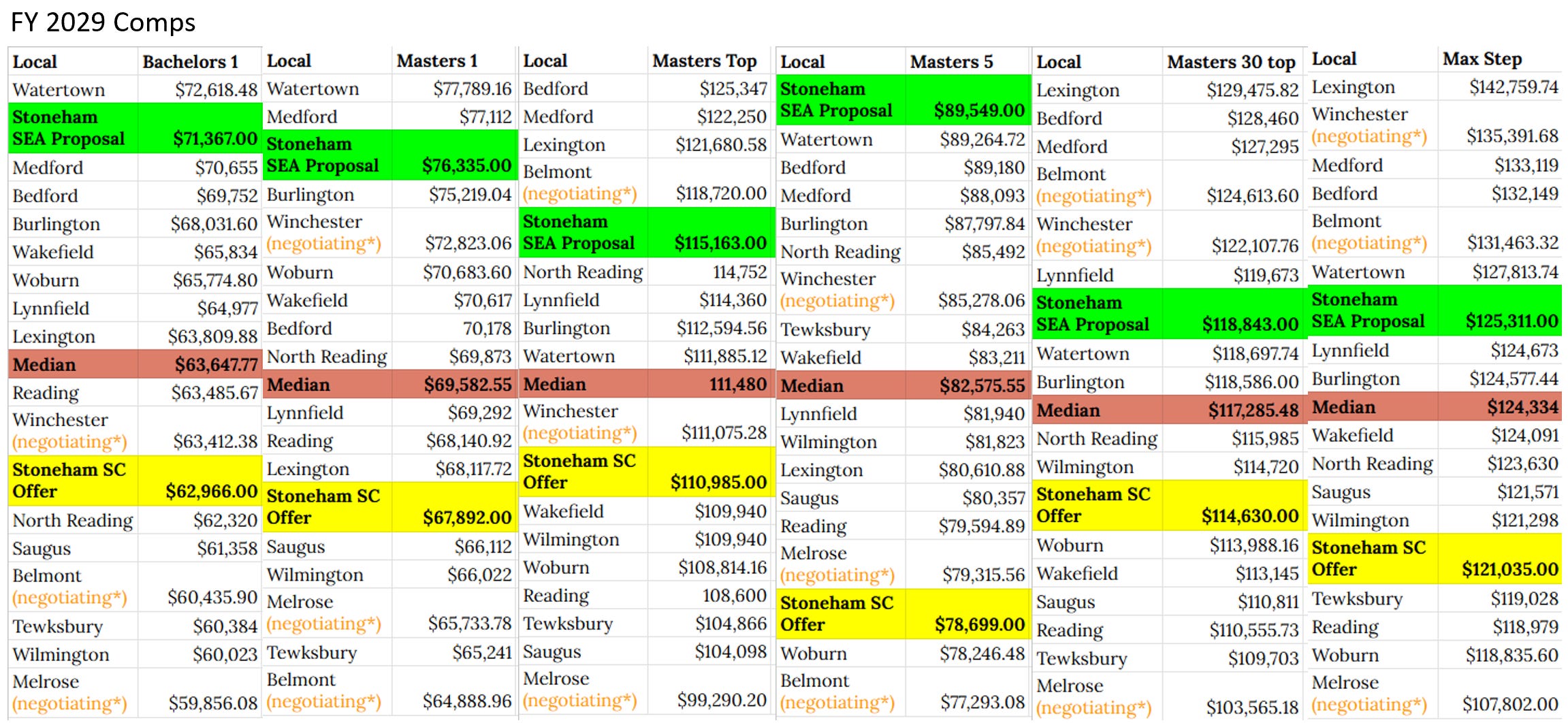
These gaps are highlighted below in data provided by the SEA. The parties are roughly 3-10% apart, depending on the Step and education level, but only 1-5% apart form the median.
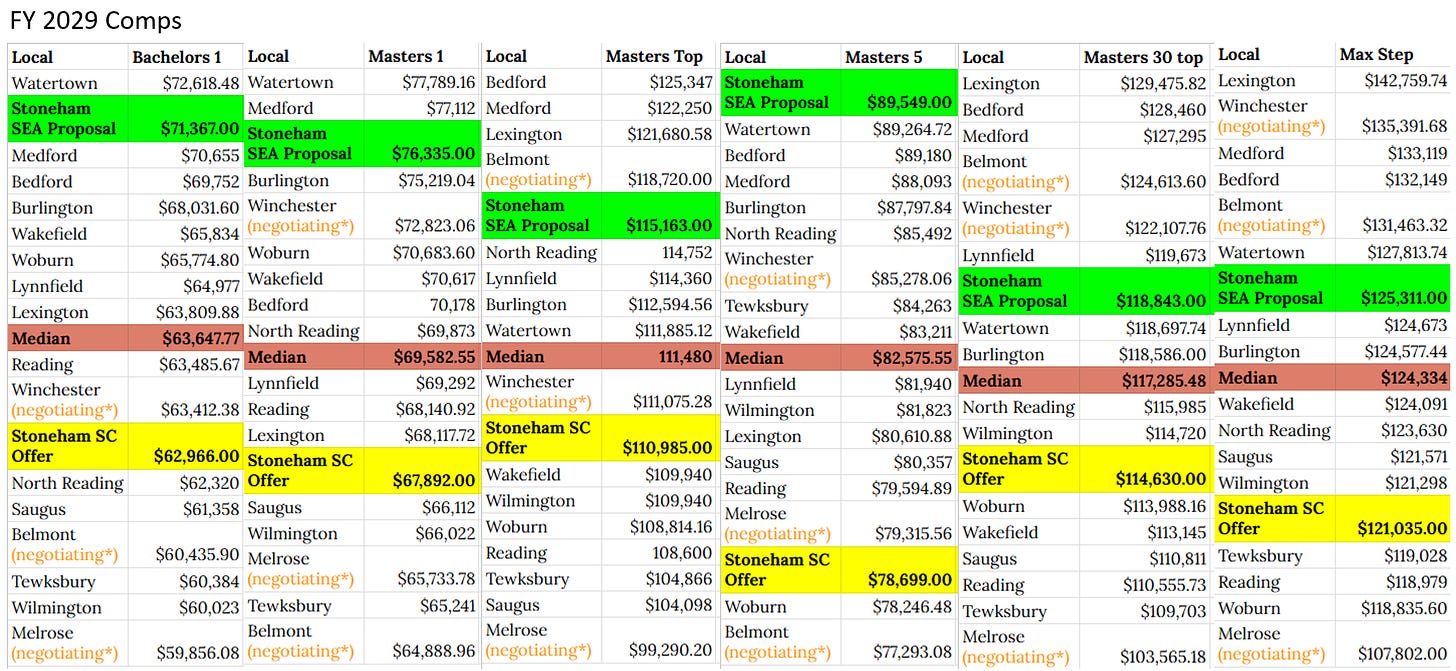
Comparison of competing salary offers at end of FY29 for teacher salaries at varying Steps vs. market for current SEA and SSC offers.
ESP Holidays
SSC proposal includes zero paid holidays for Education Support Professionals, SEA would like to change that as they are the only hourly school employees without this benefit.
The Structure of Paid Leave
Agreements reached
Tentative agreement reached to include BCBAs (Board Certified Behavior Analysts), Occupational Therapists, Physical Therapists, Therapeutic Clinicians, and Applied Behavior Analysts in the SEA.
Tentative agreement reached to provide autonomy in bereavement leave for a broader range of family members.
SSC withdrew earlier proposal to limit the use of sick time for family care.
SSC withdrew earlier proposals to restrict access to the sick-leave bank.
So Why The Beef? Disagreements on the Cost of Leave and Substitutes
From the best of my understating, there is one core issue leading to the funding gap in salaries and hindering the resolution of this contract.
Before we dive into the reason, we all need a quick primer on how sick leave works for MA teachers
Teachers in MA generally earn 12–15 sick days per year, depending on the contract.
Sick days accumulate year to year, creating what’s commonly called a sick-day bank.
Many contracts, including Stoneham’s, also allow teachers to use sick days to care for an ill family member, though the specifics (definitions of “family,” limits per year, documentation requirements) vary by district.
Many MA districts, including Stoneham, also maintain a Sick Leave Bank, a shared pool of days contributed by educators. If a teacher faces a serious illness or perhaps family leave, and exhausts their personal sick-day bank, they can apply to the shared bank for additional paid days.
In practice, teachers often “stack” benefits:
Use accrued sick days for medical recovery (e.g., childbirth).
Use Paid Family Leave
Access FMLA for bonding or family care.
Apply to the Sick Leave Bank if a major medical event exceeds their available time.
The good news - both the SEA and SC proposals agreed to expand the current parental leave to 12 weeks. The disagreement is the composition of this leave, or as it relates to the salary above, the cost of this benefit.
Current Benefit: 8 weeks accrued sick + 4 weeks unpaid FLMA
SEA Proposal: 8 weeks paid leave + 4 weeks accrued sick
SSC Proposal: 2 weeks paid leave + 10 weeks accrued sick
The gap is seemingly six weeks, but the SEA makes the point on budgeting
The actual increase in paid time off is only 4 weeks - the 4 weeks unpaid FMLA
The district’s cost savings from employees taking unpaid FMLA time off has never been part of budget calculations (and is not always taken).
The only budget change that needs to be accounted for is an additional 4 weeks of substitute pay
So, the final impact of this increase in substitute pay, based on historical trends of leave, is outlined below.
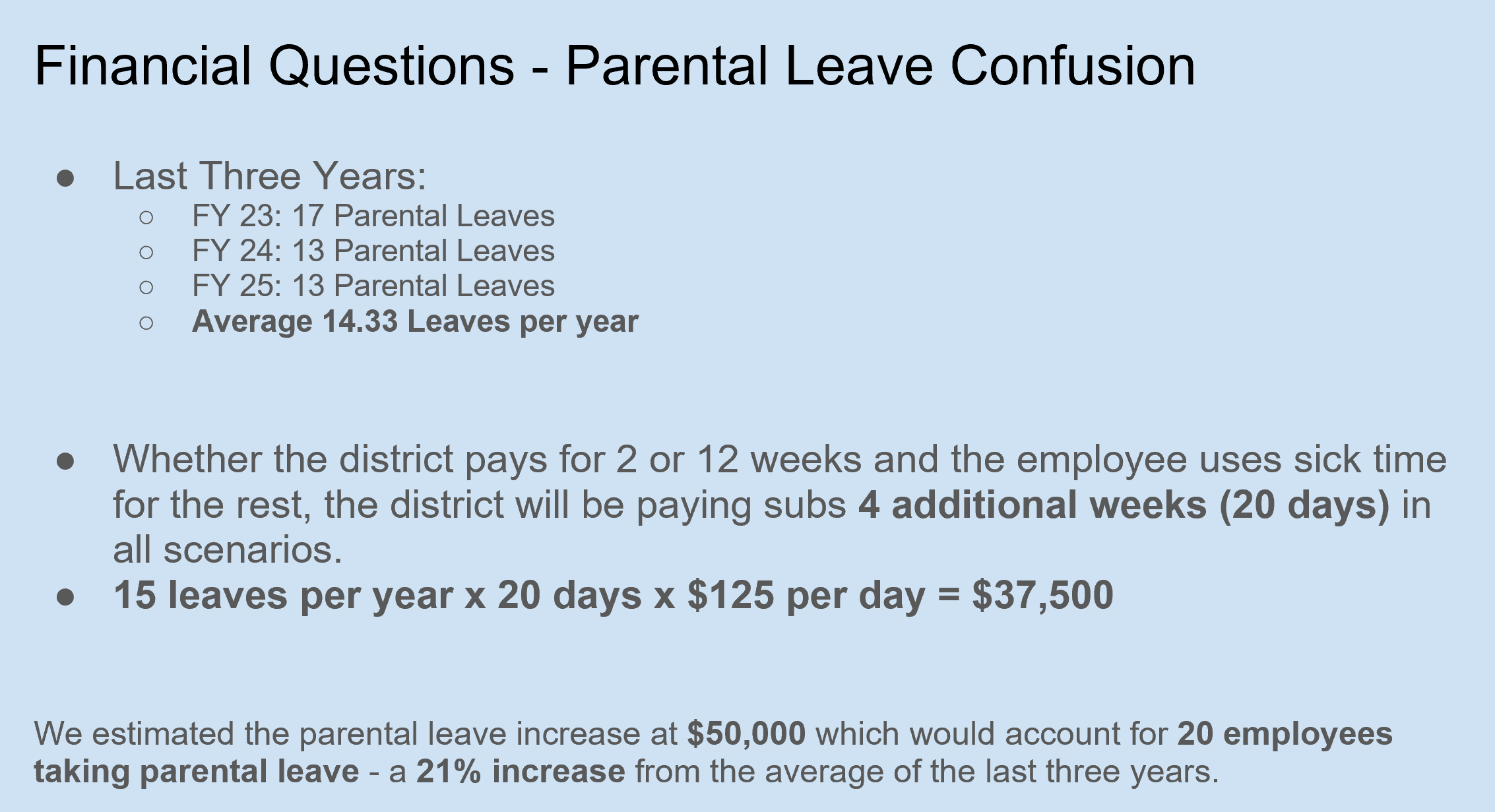
SEA assumptions on annual parental leave and the corresponding budget allocation.
So What Do the Final Differences Say?
The SEA proposal, by their calculations, have fully accounted for the $4.6M recommended override allocation to teacher contracts. According to the shared math.
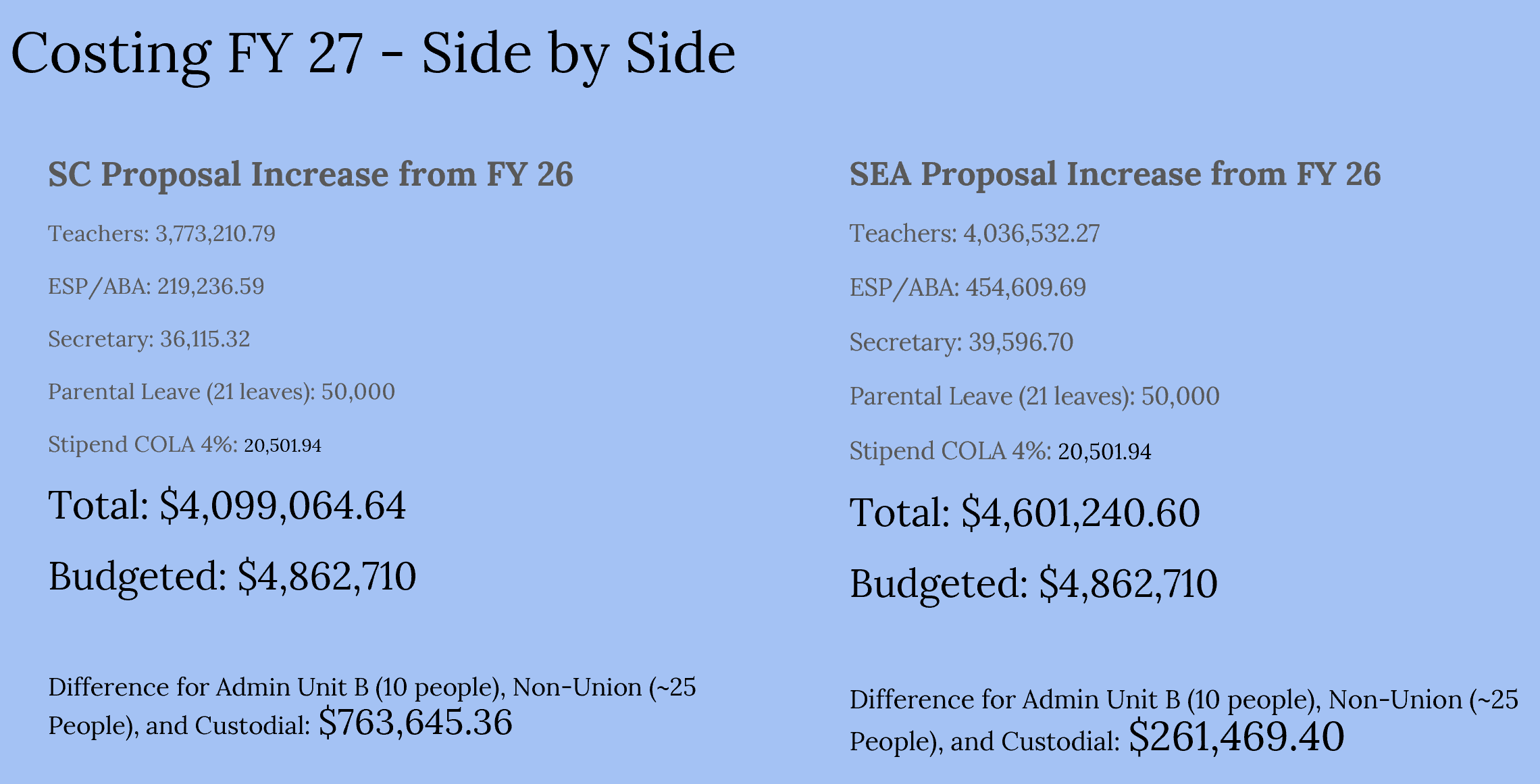
Side-side comparisons of SSC (SC) and SEA contract proposal costs for FY27.
Finally, it is important to understand how the proposed SEA contract paces out over the next three years. The SEA’s financial proposal, based on the math they have shared publicly, fits within the $4.6 million FY27 school allocation anticipated from the December 9th override. While the proposal does assume annual growth above the standard 2.5% levy limit, those increases remain within the targeted budget projections for FY28 and FY29 that the district and town have already modeled as part of the override plan. In practical terms, the SEA proposal positions Stoneham to avoid the familiar pattern where educators fall so far behind the market that the next negotiation cycle requires another major infusion of new revenue just to catch up. The goal is a sustainable trajectory, one where, three years from now, Stoneham is not once again negotiating from a position of structural underpayment but instead maintaining competitiveness through predictable, planned growth.
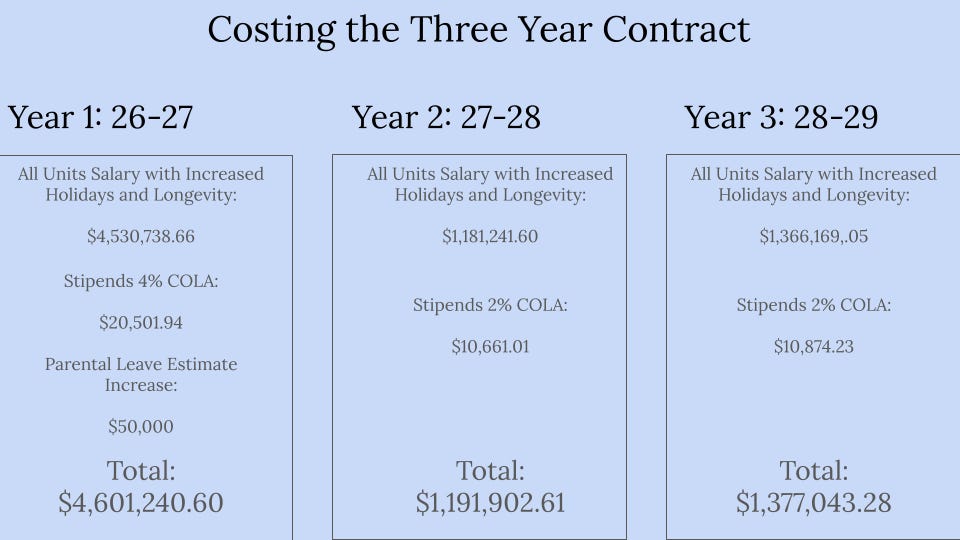
Current SEA proposal for full contract cost annual increases.
Closing Thoughts
I usually keep comments turned off on Civic Ledger articles as municipal finance and politics can be a magnet for unproductive trolling, and the goal here has always been clarity, not chaos. But for this topic, teacher contract negotiations, the math behind them, and the assumptions that shape our long‑term planning, I’m making an exception.
For this article, comments will be turned on.
So I’m inviting you, residents, educators, parents, taxpayers, and anyone who cares about Stoneham’s future, to help pressure‑test the numbers. If you see an error, call it out. If you think an assumption is off, tell us the right one. If there’s a perspective missing, add it. This is how communities get smarter together.
The stakes are real, and the decisions we make now will shape our schools and our town for years. Let’s make sure the conversation is informed, constructive, and grounded in shared facts.
Why does this seem so one sided? Did you actually talk with the superintendent or just the SEA? And it’s interesting that you have this information when negotiations are done in executive session. So I guess someone is talking when they aren’t supposed to. Just seems like if you want to give people facts you get them from both sides. I would expect you to know that since you are a member of the Stoneham FAB.